
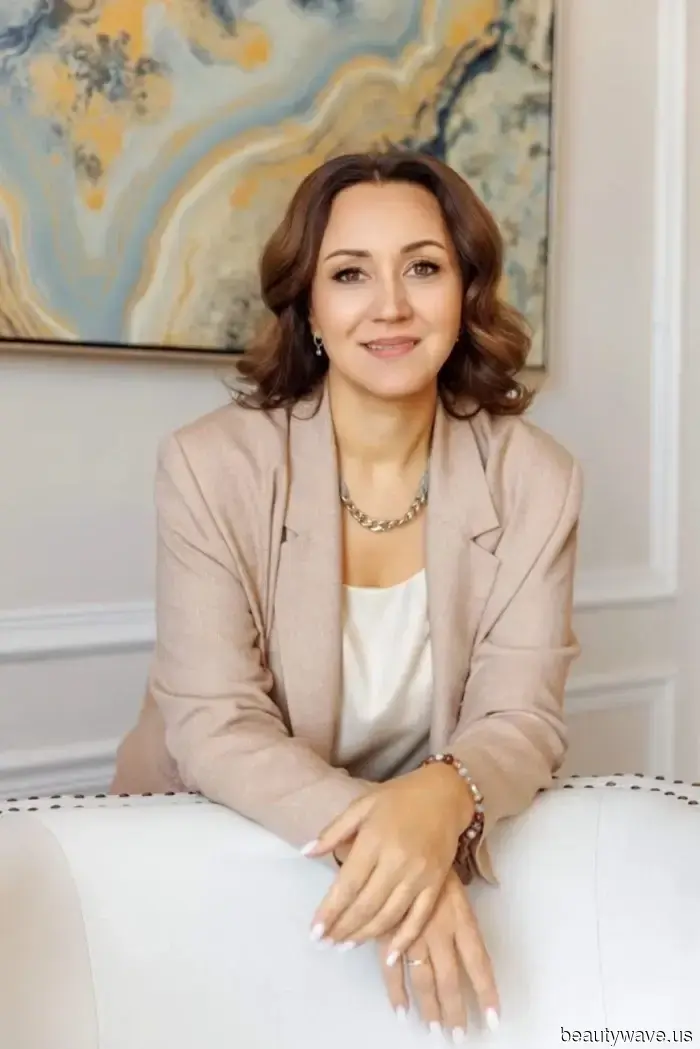
"Modern children are different": neuropsychologist Alena Istomina in an exclusive interview for Moda Topical on why we should not rush development.
Today, parents strive to give their children everything at once: early reading, English from the age of three, preparation for school almost from infancy. But why are more and more children facing anxiety, speech problems, and difficulties with concentration? Neuropsychologist Alena Istomina shared with the magazine Moda Topical in an interview how gadgets affect the child's brain, why the games of our childhood were the best neurotraining, and how to understand if a child is truly ready for school.
Neuropsychologist Alena Istomina on modern children, speech, neurogames, and why we shouldn't rush into school
— Today, parents are literally obsessed with early development. English from three years old, reading from four, preparation for school from five. How necessary is this for a child?
— Modern parents live in constant anxiety: "What if my child falls behind?" But a child's brain develops in stages, and each stage has its own tasks. In preschool age, the main work of the brain is not reading or multiplication tables, but the development of the body, emotions, speech, imagination, and the ability to interact with the world. When we start to "seat" a child for academic skills too early, we sometimes miss fundamental things: coordination, sensory development, emotional resilience. Without this, difficulties arise in school later on — from attention problems to anxiety and burnout even in the early grades.
— Then the main question for all mothers is: at what age is it better to start school?
— Generally speaking, it is recommended to send a child to school at the age of seven. By this age, they are usually emotionally, psychologically, and physiologically ready. But if at the time of enrollment the child is, for example, 6 years and 10 months old, and the parents have doubts, it is better to consult a specialist for an assessment of school readiness. A specialist can help understand how ready the child really is for learning. However, it is still not recommended to send a child to school at six and a half years old — in most cases, they are not yet ready for the school workload.
— Many parents complain that modern children are "different": they speak worse, get tired faster, and cannot play independently. Have you noticed this?
— Yes, and this is indeed a trend of recent years. The modern child lives in a world of constant stimulation: tablets, fast cartoons, short videos, a huge amount of visual noise. The brain finds it difficult to maintain attention on one thing.
Moreover, children are moving less and playing fewer live games. Yet it is through movement and play that the most important neural connections are formed. Remember our childhood: rubber bands, hopscotch, dodgeball, yard games, counting rhymes. These were not just entertainments — they were powerful neuropsychological training.
— So, were the games of the 90s more beneficial than modern developmental apps?
— In many ways — yes. Because they developed the child comprehensively. When a child jumps in hopscotch, they train coordination, balance, attention, and spatial thinking. When they play "the sea is restless" — they learn self-control and switching. When they engage in role-playing games in the yard — they develop speech, emotional intelligence, and the ability to negotiate.
Today, many skills are attempted to be replaced by gadgets and apps. But a screen cannot provide the brain with a full sensory experience. You cannot develop the body through a tablet. And the body is directly linked to the development of the brain.
— Neurogames are very popular now. What are they and do they really work?
— Neurogames are exercises that help develop interhemispheric connections, attention, memory, speech, coordination, and self-regulation. The good news is that many of them can be done at home literally in between tasks.
For example, games with cross movements: touching the left knee with the right hand, simultaneously performing different movements with the hands, rhythmic exercises, ball games. Finger games are very beneficial, especially for toddlers, because the development of fine motor skills is directly related to speech.
But it is important to understand: neurogames are not a magic pill. They work only in a system and only when the child lives a full life — sleeps, moves, plays, and communicates.
— You mentioned speech. Many mothers worry that children start speaking later. Is this really happening more often?
— Yes, and this is one of the most pressing topics today. The number of speech delays is increasing. There are many reasons: a decrease in live communication, an excess of screen time, a high level of anxiety among parents, and a lack of movement.
Speech does not develop "on its own." A child needs dialogue for it. Not the background noise of the TV, but live communication: when the mother looks into the eyes, responds, discusses, reads books, sings songs.
Sometimes parents say: "He understands everything, he just is lazy to speak." But if by two and a half to three years there is almost no speech, it is better not to wait and not to listen to advice that "he will outgrow it." The sooner help begins, the easier it is for the brain to compensate for difficulties.
— Is it true that gadgets directly affect speech development?
— Absolutely. Especially at an early age. When a child spends a long time in front of a screen, the brain receives a ready-made picture and does not learn to create it independently. Moreover, the screen does not require dialogue. And speech develops precisely in response and interaction.
I am not an advocate of demonizing technology — we still live in a digital world. But for a small child, real life should be much brighter than virtual life. No cartoon can replace playing with mom, a sandbox, bedtime stories, or cooking together in the kitchen.
— Today, parents often try to be "perfect." How does this affect children?
— Very significantly. Modern mothers are incredibly tired. They try to be successful, beautiful, conscious, control everything, and at the same time raise the "perfect child." Children feel this.
In fact, a child does not need a perfect mother. They need a living, calm, emotionally available mother. One with whom they feel safe. Because the feeling of safety is the foundation of a healthy psyche.
— What would you like to say to the women reading this interview?
— Do not compare your child to others. Every brain has its own pace of development. Sometimes the most important thing we can give children is not endless classes and activities, but childhood: movement, play, conversations, hugs, and the feeling that there is an adult nearby who loves and accepts them.
And perhaps the main thing: a happy child is not the one who started reading before everyone else. But the one who feels loved, confident, and alive.

"Modern children are different": neuropsychologist Alena Istomina in an exclusive interview for Moda Topical on why we should not rush development.
Today, parents strive to give their children everything at once: early reading, English from the age of three, preparation for school almost from infancy. But why are more and more children facing anxiety, speech problems, and difficulties with concentration? Neuropsychologist Alena Istomina shared in an interview with Moda Topical magazine how gadgets affect the child's brain, why...